 Add to Chrome
 Add to Firefox
 Add to Edge
Unregularized Linear Convergence in Zero-Sum Game from Preference Feedback
Dec 31, 2025
Aligning large language models (LLMs) with human preferences has proven effective for enhancing model capabilities, yet standard preference modeling using the Bradley-Terry model assumes transitivity, overlooking the inherent complexity of human population preferences. Nash learning from human feedback (NLHF) addresses this by framing non-transitive preferences as a two-player zero-sum game, where alignment reduces to finding the Nash equilibrium (NE). However, existing algorithms typically rely on regularization, incurring unavoidable bias when computing the duality gap in the original game. In this work, we provide the first convergence guarantee for Optimistic Multiplicative Weights Update ($\mathtt{OMWU}$) in NLHF, showing that it achieves last-iterate linear convergence after a burn-in phase whenever an NE with full support exists, with an instance-dependent linear convergence rate to the original NE, measured by duality gaps. Compared to prior results in Wei et al. (2020), we do not require the assumption of NE uniqueness. Our analysis identifies a novel marginal convergence behavior, where the probability of rarely played actions grows exponentially from exponentially small values, enabling exponentially better dependence on instance-dependent constants than prior results. Experiments corroborate the theoretical strengths of $\mathtt{OMWU}$ in both tabular and neural policy classes, demonstrating its potential for LLM applications.

Understanding the Gain from Data Filtering in Multimodal Contrastive Learning
Dec 16, 2025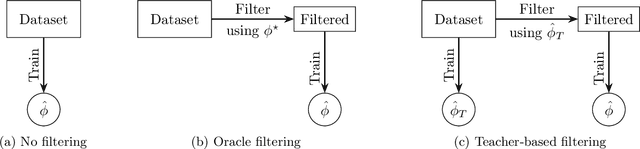
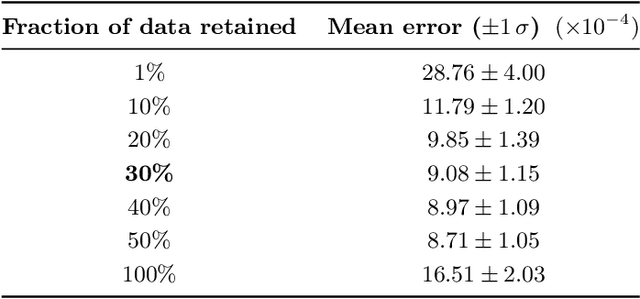
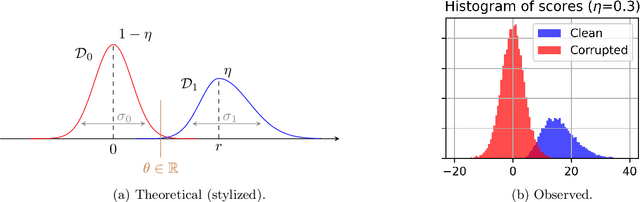
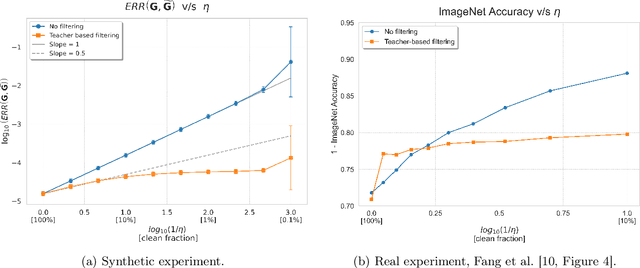
The success of modern multimodal representation learning relies on internet-scale datasets. Due to the low quality of a large fraction of raw web data, data curation has become a critical step in the training pipeline. Filtering using a trained model (i.e., teacher-based filtering) has emerged as a successful solution, leveraging a pre-trained model to compute quality scores. To explain the empirical success of teacher-based filtering, we characterize the performance of filtered contrastive learning under the standard bimodal data generation model. Denoting $η\in(0,1]$ as the fraction of data with correctly matched modalities among $n$ paired samples, we utilize a linear contrastive learning setup to show a provable benefit of data filtering: $(i)$ the error without filtering is upper and lower bounded by $\frac{1}{η\sqrt{n}}$, and $(ii)$ the error with teacher-based filtering is upper bounded by $\frac{1}{\sqrt{ηn}}$ in the large $η$ regime, and by $\frac{1}{\sqrt{n}}$ in the small $η$ regime.
Sharp Gap-Dependent Variance-Aware Regret Bounds for Tabular MDPs
Jun 06, 2025We consider the gap-dependent regret bounds for episodic MDPs. We show that the Monotonic Value Propagation (MVP) algorithm achieves a variance-aware gap-dependent regret bound of $$\tilde{O}\left(\left(\sum_{\Delta_h(s,a)>0} \frac{H^2 \log K \land \mathtt{Var}_{\max}^{\text{c}}}{\Delta_h(s,a)} +\sum_{\Delta_h(s,a)=0}\frac{ H^2 \land \mathtt{Var}_{\max}^{\text{c}}}{\Delta_{\mathrm{min}}} + SAH^4 (S \lor H) \right) \log K\right),$$ where $H$ is the planning horizon, $S$ is the number of states, $A$ is the number of actions, and $K$ is the number of episodes. Here, $\Delta_h(s,a) =V_h^* (a) - Q_h^* (s, a)$ represents the suboptimality gap and $\Delta_{\mathrm{min}} := \min_{\Delta_h (s,a) > 0} \Delta_h(s,a)$. The term $\mathtt{Var}_{\max}^{\text{c}}$ denotes the maximum conditional total variance, calculated as the maximum over all $(\pi, h, s)$ tuples of the expected total variance under policy $\pi$ conditioned on trajectories visiting state $s$ at step $h$. $\mathtt{Var}_{\max}^{\text{c}}$ characterizes the maximum randomness encountered when learning any $(h, s)$ pair. Our result stems from a novel analysis of the weighted sum of the suboptimality gap and can be potentially adapted for other algorithms. To complement the study, we establish a lower bound of $$\Omega \left( \sum_{\Delta_h(s,a)>0} \frac{H^2 \land \mathtt{Var}_{\max}^{\text{c}}}{\Delta_h(s,a)}\cdot \log K\right),$$ demonstrating the necessity of dependence on $\mathtt{Var}_{\max}^{\text{c}}$ even when the maximum unconditional total variance (without conditioning on $(h, s)$) approaches zero.
Global Convergence of Gradient EM for Over-Parameterized Gaussian Mixtures
Jun 06, 2025Learning Gaussian Mixture Models (GMMs) is a fundamental problem in machine learning, with the Expectation-Maximization (EM) algorithm and its popular variant gradient EM being arguably the most widely used algorithms in practice. In the exact-parameterized setting, where both the ground truth GMM and the learning model have the same number of components $m$, a vast line of work has aimed to establish rigorous recovery guarantees for EM. However, global convergence has only been proven for the case of $m=2$, and EM is known to fail to recover the ground truth when $m\geq 3$. In this paper, we consider the $\textit{over-parameterized}$ setting, where the learning model uses $n>m$ components to fit an $m$-component ground truth GMM. In contrast to the exact-parameterized case, we provide a rigorous global convergence guarantee for gradient EM. Specifically, for any well separated GMMs in general position, we prove that with only mild over-parameterization $n = \Omega(m\log m)$, randomly initialized gradient EM converges globally to the ground truth at a polynomial rate with polynomial samples. Our analysis proceeds in two stages and introduces a suite of novel tools for Gaussian Mixture analysis. We use Hermite polynomials to study the dynamics of gradient EM and employ tensor decomposition to characterize the geometric landscape of the likelihood loss. This is the first global convergence and recovery result for EM or Gradient EM beyond the special case of $m=2$.
Understanding the Performance Gap in Preference Learning: A Dichotomy of RLHF and DPO
May 26, 2025We present a fine-grained theoretical analysis of the performance gap between reinforcement learning from human feedback (RLHF) and direct preference optimization (DPO) under a representation gap. Our study decomposes this gap into two sources: an explicit representation gap under exact optimization and an implicit representation gap under finite samples. In the exact optimization setting, we characterize how the relative capacities of the reward and policy model classes influence the final policy qualities. We show that RLHF, DPO, or online DPO can outperform one another depending on the type of model mis-specifications. Notably, online DPO can outperform both RLHF and standard DPO when the reward and policy model classes are isomorphic and both mis-specified. In the approximate optimization setting, we provide a concrete construction where the ground-truth reward is implicitly sparse and show that RLHF requires significantly fewer samples than DPO to recover an effective reward model -- highlighting a statistical advantage of two-stage learning. Together, these results provide a comprehensive understanding of the performance gap between RLHF and DPO under various settings, and offer practical insights into when each method is preferred.
Improving Human-AI Coordination through Adversarial Training and Generative Models
Apr 21, 2025Being able to cooperate with new people is an important component of many economically valuable AI tasks, from household robotics to autonomous driving. However, generalizing to novel humans requires training on data that captures the diversity of human behaviors. Adversarial training is one avenue for searching for such data and ensuring that agents are robust. However, it is difficult to apply in the cooperative setting because adversarial policies intentionally learn to sabotage the task instead of simulating valid cooperation partners. To address this challenge, we propose a novel strategy for overcoming self-sabotage that combines a pre-trained generative model to simulate valid cooperative agent policies with adversarial training to maximize regret. We call our method GOAT: Generative Online Adversarial Training. In this framework, the GOAT dynamically searches for and generates coordination strategies where the learning policy -- the Cooperator agent -- underperforms. GOAT enables better generalization by exposing the Cooperator to various challenging interaction scenarios. We maintain realistic coordination strategies by updating only the generative model's embedding while keeping its parameters frozen, thus avoiding adversarial exploitation. We evaluate GOAT with real human partners, and the results demonstrate state-of-the-art performance on the Overcooked benchmark, highlighting its effectiveness in generalizing to diverse human behaviors.
Cross-environment Cooperation Enables Zero-shot Multi-agent Coordination
Apr 20, 2025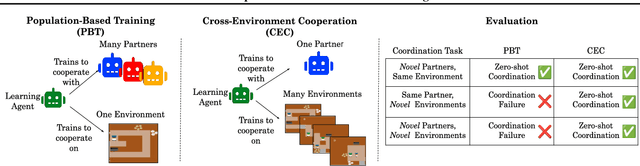
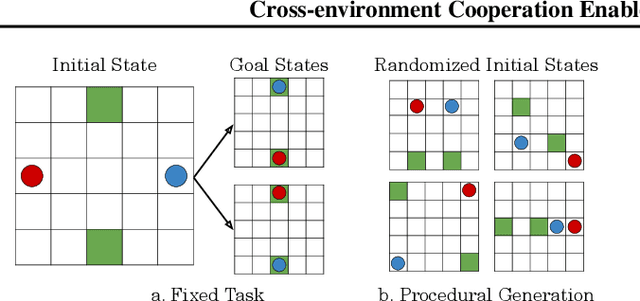
Zero-shot coordination (ZSC), the ability to adapt to a new partner in a cooperative task, is a critical component of human-compatible AI. While prior work has focused on training agents to cooperate on a single task, these specialized models do not generalize to new tasks, even if they are highly similar. Here, we study how reinforcement learning on a distribution of environments with a single partner enables learning general cooperative skills that support ZSC with many new partners on many new problems. We introduce two Jax-based, procedural generators that create billions of solvable coordination challenges. We develop a new paradigm called Cross-Environment Cooperation (CEC), and show that it outperforms competitive baselines quantitatively and qualitatively when collaborating with real people. Our findings suggest that learning to collaborate across many unique scenarios encourages agents to develop general norms, which prove effective for collaboration with different partners. Together, our results suggest a new route toward designing generalist cooperative agents capable of interacting with humans without requiring human data.
Extragradient Preference Optimization (EGPO): Beyond Last-Iterate Convergence for Nash Learning from Human Feedback
Mar 11, 2025Reinforcement learning from human feedback (RLHF) has become essential for improving language model capabilities, but traditional approaches rely on the assumption that human preferences follow a transitive Bradley-Terry model. This assumption fails to capture the non-transitive nature of populational human preferences. Nash learning from human feedback (NLHF), targeting non-transitive preferences, is a problem of computing the Nash equilibrium (NE) of the two-player constant-sum game defined by the human preference. We introduce Extragradient preference optimization (EGPO), a novel algorithm for NLHF achieving last-iterate linear convergence to the NE of KL-regularized games and polynomial convergence to the NE of original games, while being robust to noise. Unlike previous approaches that rely on nested optimization, we derive an equivalent implementation using gradients of an online variant of the identity preference optimization (IPO) loss, enabling more faithful implementation for neural networks. Our empirical evaluations demonstrate EGPO's superior performance over baseline methods when training for the same number of epochs, as measured by pairwise win-rates using the ground truth preference. These results validate both the theoretical strengths and practical advantages of EGPO for language model alignment with non-transitive human preferences.
Anytime Acceleration of Gradient Descent
Nov 26, 2024

This work investigates stepsize-based acceleration of gradient descent with {\em anytime} convergence guarantees. For smooth (non-strongly) convex optimization, we propose a stepsize schedule that allows gradient descent to achieve convergence guarantees of $O(T^{-1.03})$ for any stopping time $T$, where the stepsize schedule is predetermined without prior knowledge of the stopping time. This result provides an affirmative answer to a COLT open problem \citep{kornowski2024open} regarding whether stepsize-based acceleration can yield anytime convergence rates of $o(T^{-1})$. We further extend our theory to yield anytime convergence guarantees of $\exp(-\Omega(T/\kappa^{0.97}))$ for smooth and strongly convex optimization, with $\kappa$ being the condition number.
Learning to Cooperate with Humans using Generative Agents
Nov 21, 2024Training agents that can coordinate zero-shot with humans is a key mission in multi-agent reinforcement learning (MARL). Current algorithms focus on training simulated human partner policies which are then used to train a Cooperator agent. The simulated human is produced either through behavior cloning over a dataset of human cooperation behavior, or by using MARL to create a population of simulated agents. However, these approaches often struggle to produce a Cooperator that can coordinate well with real humans, since the simulated humans fail to cover the diverse strategies and styles employed by people in the real world. We show \emph{learning a generative model of human partners} can effectively address this issue. Our model learns a latent variable representation of the human that can be regarded as encoding the human's unique strategy, intention, experience, or style. This generative model can be flexibly trained from any (human or neural policy) agent interaction data. By sampling from the latent space, we can use the generative model to produce different partners to train Cooperator agents. We evaluate our method -- \textbf{G}enerative \textbf{A}gent \textbf{M}odeling for \textbf{M}ulti-agent \textbf{A}daptation (GAMMA) -- on Overcooked, a challenging cooperative cooking game that has become a standard benchmark for zero-shot coordination. We conduct an evaluation with real human teammates, and the results show that GAMMA consistently improves performance, whether the generative model is trained on simulated populations or human datasets. Further, we propose a method for posterior sampling from the generative model that is biased towards the human data, enabling us to efficiently improve performance with only a small amount of expensive human interaction data.